
Overview
Wire mesh, vane, and fibre-bed mist eliminators
Mist eliminators remove entrained liquid droplets from gas and vapour streams, helping recover valuable product and protect downstream equipment from corrosion and contamination.
EVERMESH wire mesh, EVERON vane, and EVERFIBRE fibre-bed mist eliminators provide options for different droplet sizes and process conditions. Selection considers liquid loading, allowable pressure drop, and the service requirements.
The group’s wire-mesh roots date to 1948.
Matching the mist to the removal method
Droplet size helps guide the choice of vanes, mesh, or fibre beds.
Equal distances from 100 to 10 and 10 to 1 µm represent tenfold reductions in droplet size. The <1 µm label denotes sub-micron duties. Bars start at the chart boundary, not a maximum droplet size. Lighter extensions represent EVERON special construction and EVERMESH co-knit designs. Refer to each product’s stated efficiency and service conditions.
Three ways droplets are captured
Inertial impaction
Larger droplets cannot follow the gas as it turns around a vane, wire or fibre, so they strike the collection surface.
Direct interception
A droplet follows the gas streamline but passes close enough for its edge to touch a wire or fibre and be captured.
Brownian diffusion
Very fine droplets move randomly as they travel with the gas, increasing their chance of contacting a fibre.
Liquid droplet Collection surface Gas flow · schematic illustrations
EVERMESH
Wire mesh demisters
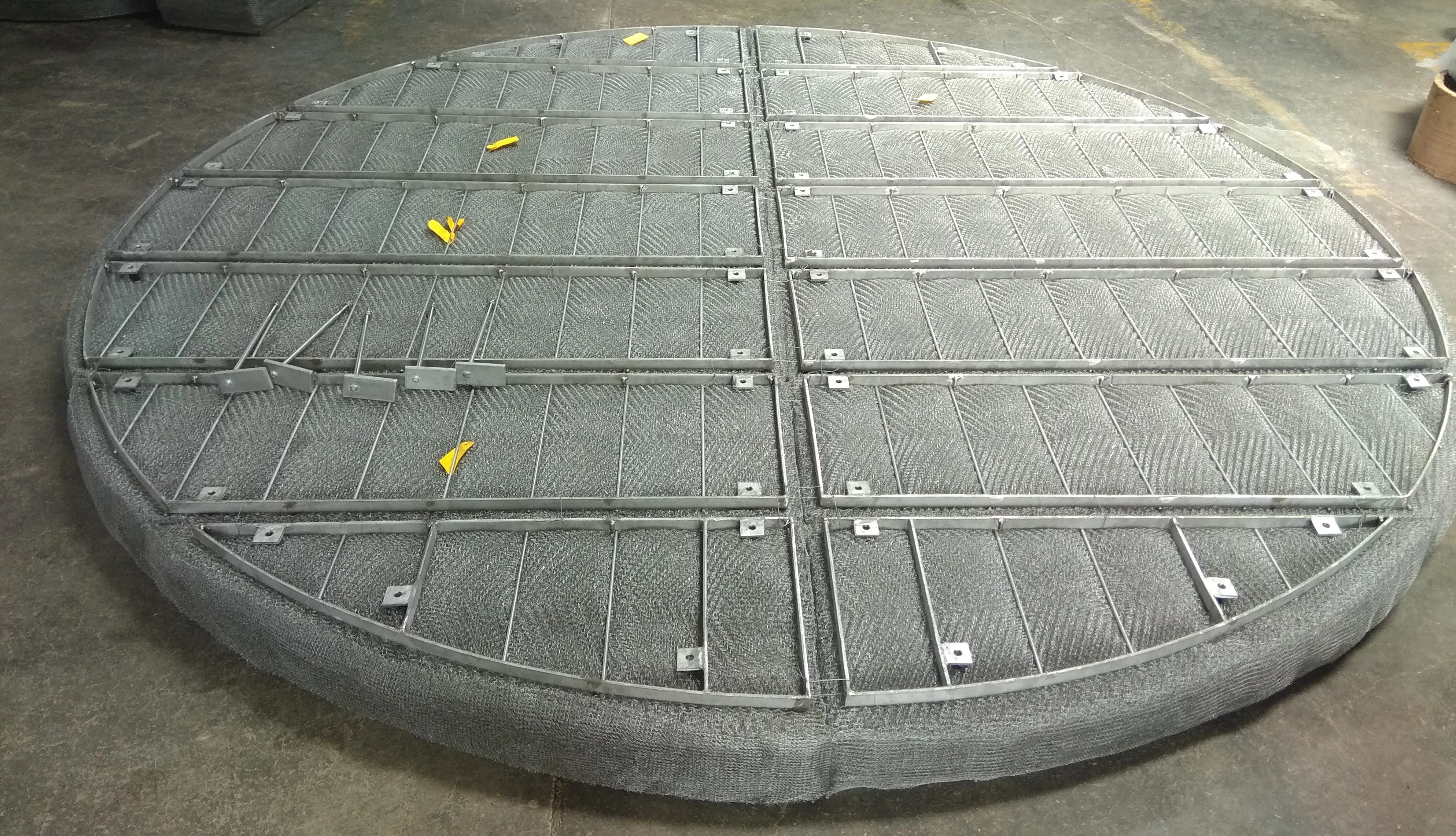
EVERMESH is a fabricated mesh pad of symmetrical interlocking knitted-wire (or plastic) loops with high free volume and a large impingement area.
As mist-laden vapour passes through the layered mesh, liquid droplets have greater inertia than the vapour and impinge on the exposed wire or plastic surfaces. The droplets collect and coalesce, growing until they are large enough to drain back into the system. This reduces liquid carry-over in the outgoing vapour.
EVERMESH removes droplets down to 5 microns at up to 99% efficiency. The pressure drop across the mesh pad is typically below 25 mm H₂O.
EVERMESH is installed in evaporators, scrubbers, KO drums, and pressure vessels — usually without a special housing. Most pads ship with rigid support and hold-down grids for direct installation onto vessel rings or beams. Sectional construction allows handling through manways.
Standard pad styles
Swipe to view all columns →
| Style | Density kg/m³ | Voids % | Contact surface area m²/m³ | Characteristic |
|---|---|---|---|---|
| GA | 80 | 99 | 160 | High Vacuum |
| GA1 | 100 | 98.75 | 200 | High Throughput |
| GB | 144 | 98.2 | 280 | Standard |
| GC1 | 173 | 97.8 | 360 | Dense |
| GC | 193 | 97.5 | 360 | Extra Dense |
| GD | 220 | 97.2 | 905 | Heavy Dense |
| GE | 432 | 94.5 | 1960 | Multi-Strand |
| GS | 128 | 98.4 | 460 | High Efficiency |
| GT* | 64 | 97 | 440 | Dense |
| GP# | 75 | 93 | 1100 | Heavy Dense |
Typical materials of construction: GT* — FEP; GP# — polypropylene.
EVERMESH N-series
Composite multilayer designs
Evergreen has developed multiple/dual-density mesh styles to improve mist-eliminator capacity and performance compared with conventional styles. These styles provide:
- 10–15% lower pressure drop.
- 20–40% higher design velocity.
- Equivalent collection efficiency.
- Increased fouling resistance.
EVERMESH Plus
Mesh + vane combinations
Combines mesh and vane eliminator types in a single assembly to optimise gas/vapour throughput, liquid loading, collection efficiency, and pressure drop. For high-pressure steam drums, natural gas dehydration, multiple-effect evaporators.
EVERMESH Co-knit
Multi-filament yarn construction
Incorporates multi-filament yarn (polyester, glass fibre, or PTFE) with metal wires for higher collection efficiency of up to 99% removal down to 2 microns. A drainage layer at the bottom allows fast evacuation of collected liquid.
EVERON
Vane / chevron mist eliminators
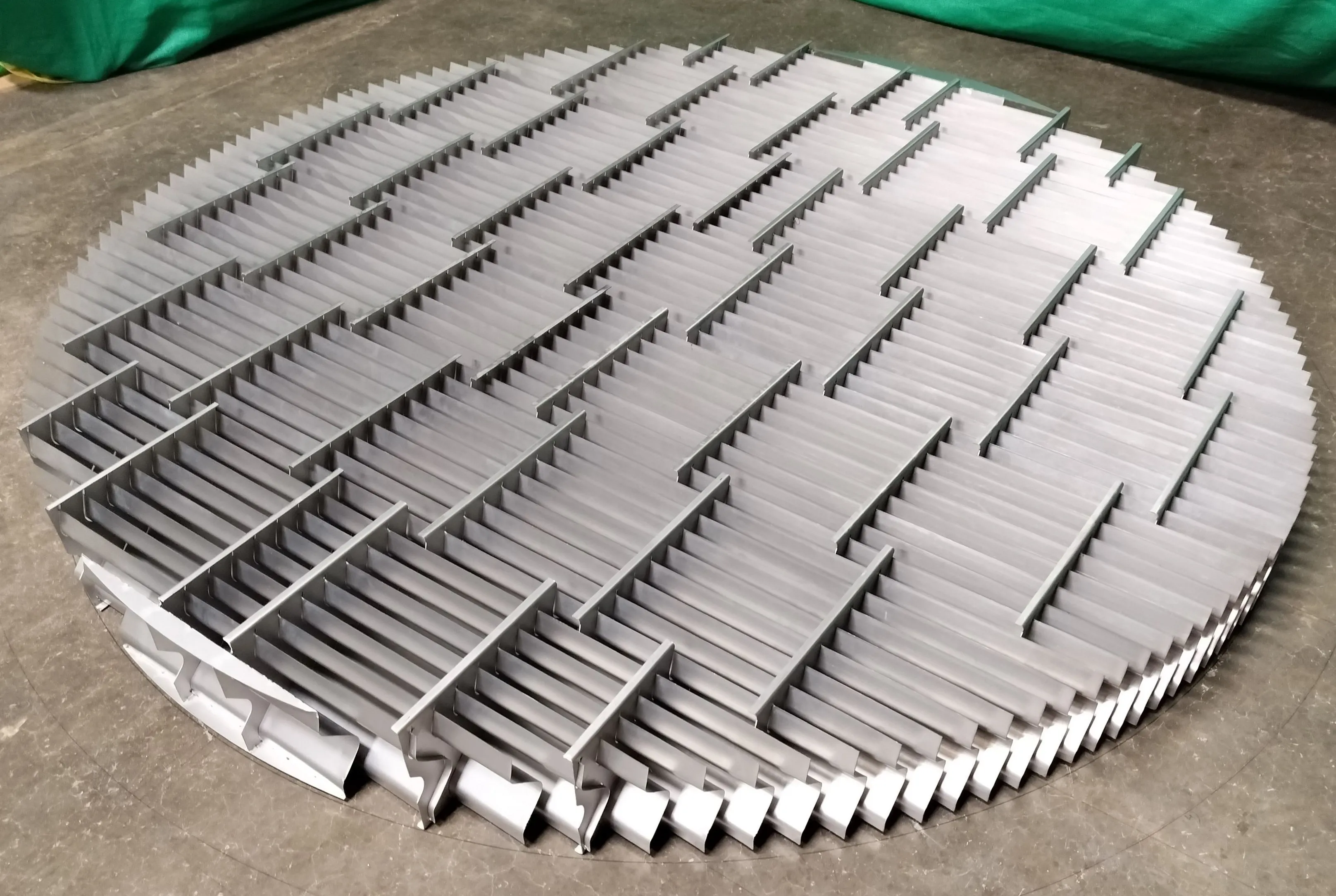
EVERON is constructed using specially designed vanes with a well-defined geometry. When gas streams negotiate the zig-zag contours, liquid particles impinge on the vane walls due to their higher inertia and coalesce into larger drops that drain. EVERONs perform well even in high pressure environments. These vane type mist eliminators provide low fouling, a wide operating range, and low pressure drop.
EVERON VFH
Vertical Flow — Horizontally Placed
For vertical gas flow with counter-current liquid drainage. Standard limit drop size in the region of 25 microns; 99% removal of 25+ micron droplets. Pressure drop typically <1 mbar.
EVERON HFV
Horizontal Flow — Vertically Placed
They are designed with largely sinusoidal vanes. These vanes may contain phase-separation chambers to prevent re-entrainment. Special designs are available for these products with limit drop sizes down to 5 microns. They can operate at higher velocities than VFH type mist eliminators.
EVERON HFV-IV
High-pressure (>10 bar)
Designed for critical high-pressure applications, including offshore platforms. Provides 99.75% removal efficiency for droplets larger than 8 microns, whilst keeping the pressure drop below 0.1 kg/cm². Operating references are available at pressures up to 100 bar, with guaranteed outlet liquid carry-over below 0.1 USG/MMSCF.
EVERON HFV-DP
Double pocket
A high-efficiency design with a smaller equipment footprint. Phase-separation chambers help prevent re-entrainment. The compact design allows smaller vessels in greenfield projects and accommodates higher gas loads in existing vessels through internals-only changes during revamps.
EVERON VFH IIa
Direct retrofit
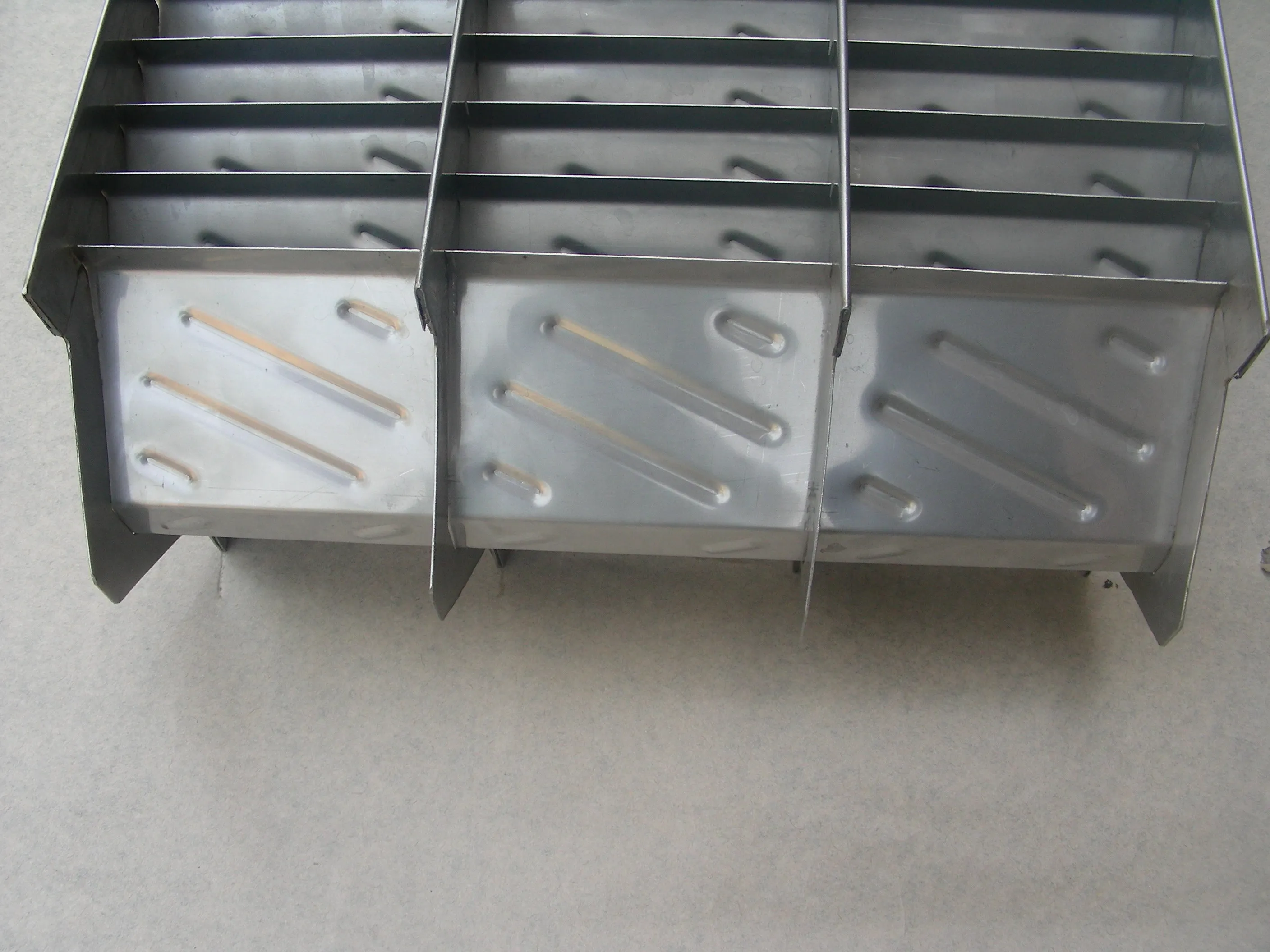
EVERON VFH IIa is manufactured in the same standard sizes as the established vertical-flow vane mist eliminators it replaces, enabling like-for-like replacement. Sectional construction allows installation through existing manways.
EVERON + EVERMESH
Combination eliminators
EVERMESH coalesces fine aerosols into larger droplets. The gas then passes through an EVERON VFH or HFV vane mist eliminator, which removes these droplets. This combination is effective down to 5 microns.
EVERFIBRE
Fibre-bed mist eliminators — for fine mist particulate removal
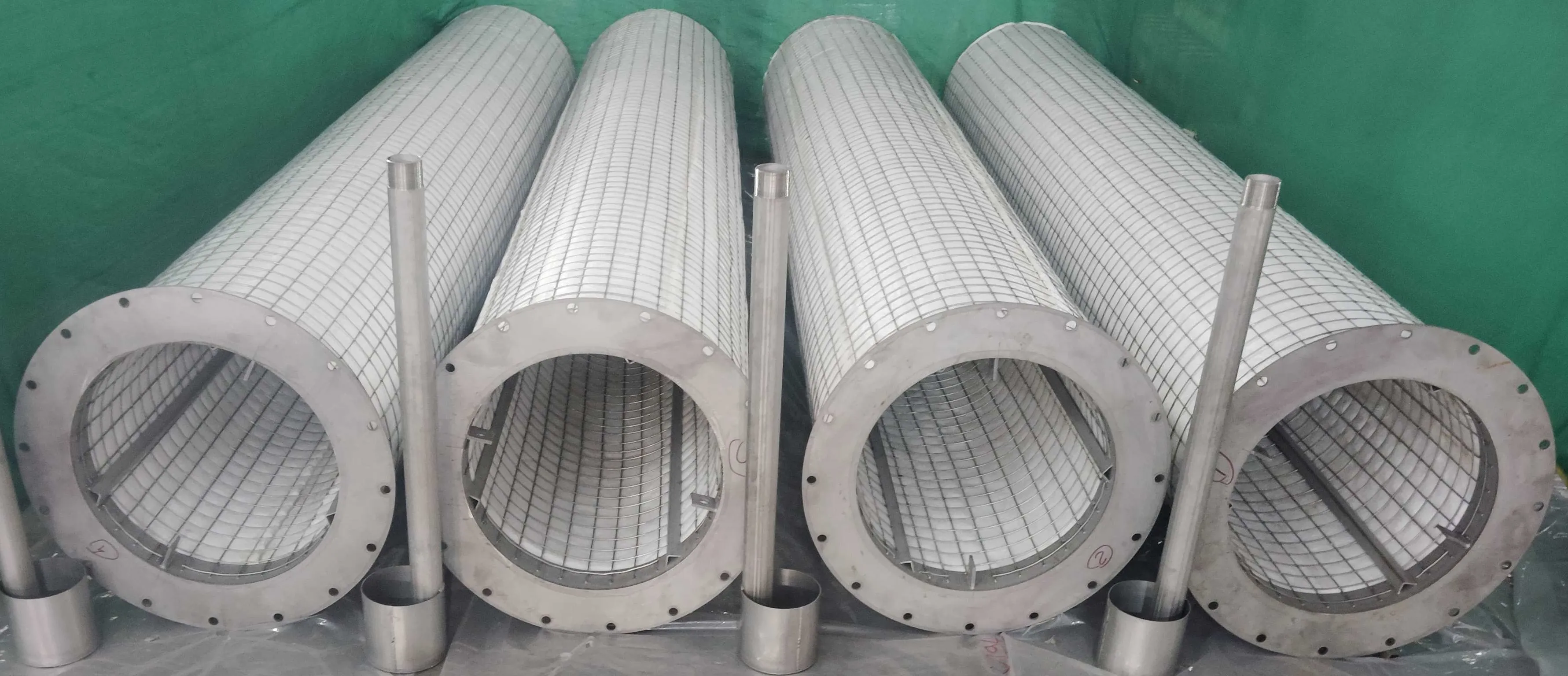
The EVERFIBRE Bed Mist Eliminator is the result of a detailed investigation of mist characteristics and laboratory studies of fibre and surface treatments. The unit consists of fibres packed between concentric corrosion-resistant screens (stainless steel, fibre-reinforced plastics (FRP), polypropylene, PVDF, titanium, etc.); the type, the orientation, the fibre-bed depth, and packing density are tailored to the application.
Coarse particles are removed by impaction and direct interception. Finer particles are captured by Brownian diffusion. EVERFIBRE finds wide application in plants working with sulphuric acid, sulphonation, chlorine, nitric acid, ammonium nitrate, and compressed gases. It helps plants conform to national emission standards.
In sulphuric acid plants, EVERFIBRE is used for acid mist removal in drying towers, inter-pass absorption towers (IAT/IPAT), and final absorption towers (FAT).
Media options
Swipe to view all columns →
| Media | Mechanism | Removal efficiency by droplet size | Pressure Loss |
|---|---|---|---|
| Glass Fibre HE (GFR/GFM) | Brownian diffusion — highest efficiency | 100% for droplets >3 µm 99% for droplets <3 µm | 150–250 mm H₂O |
| Glass Fibre HF (GFC) | Interception and Impaction — high gas volume | 100% for droplets >3 µm 70–95% for droplets <3 µm | 100–200 mm H₂O |
| Polypropylene/polyester | Brownian diffusion — alkaline / corrosive service | 100% for droplets >3 µm 95% for droplets 1–3 µm 90% for droplets 0.5–1 µm | 100–250 mm H₂O |
SFFF
Standard Flange Forward Flow
The elements hang from a tubesheet. Mist-laden gas flows from outside the element, through the media and the clean gas exits through the inner core. High-efficiency elements are recommended in this configuration.
RFUSD
Reverse-Flow Upside Down
The elements are mounted vertically on the tubesheet. Gas flows from the central core of the element outward through the media. This configuration reduces the required housing vessel size. Only high-flow elements are recommended for this arrangement in order to control re-entrainment.
Applications
Where Evergreen mist eliminators are installed
- Distillation columns and overheads
- Evaporators and crystallisers
- Knockout drums
- Vacuum towers
- Gas scrubbing systems
- Steam drums
- Sulphuric acid plants
- Sulphonation reactors
- Chlorine cells
- Nitric acid plants
- Ammonium nitrate plants
- Compressed gas systems
- Natural gas dehydration
- Olefin and methanol production
- Fertilizer plants
- Oil refineries and petrochemicals